
In Vitro testing
In Vitro testing services based on human tissue models provide reliable, scientifically validated, and ethically acceptable alternatives to traditional animal testing. These methods are fully aligned with the 3Rs principles (Replacement, Reduction, and Refinement) and contribute to improving the safety assessment of chemicals and products across different exposure routes.
QACS offers a comprehensive portfolio of in vitro testing services for product safety evaluation. By using non-animal models, cell cultures, and reconstructed 3D human tissues, we assess the toxicological potential of raw materials and finished products, including their ability to cause irritation, corrosion, cytotoxicity, and/or genotoxic effects. In addition, specialized cell lines are employed to evaluate the impact of environmental stress factors on final products, such as UV radiation in sunscreen formulations.
The experimental unit of QACS operates under GLP certification and is organized in accordance with the OECD Principles of Good Laboratory Practice (GLP) for the conduct of toxicological studies. Our facilities support safety assessments for pharmaceuticals, cosmetics, disinfectants, chemicals, and medical devices, ensuring high scientific standards, regulatory compliance, and reliable results.
Available In Vitro tests
In vitro Eye Irritation OECD 492
Overview
Eye irritation potential is evaluated using the EpiOcular™ reconstructed human corneal epithelium (RhCE), a three‑dimensional human tissue model that closely mimics the structure and physiological response of the human cornea.
Τest Protocol
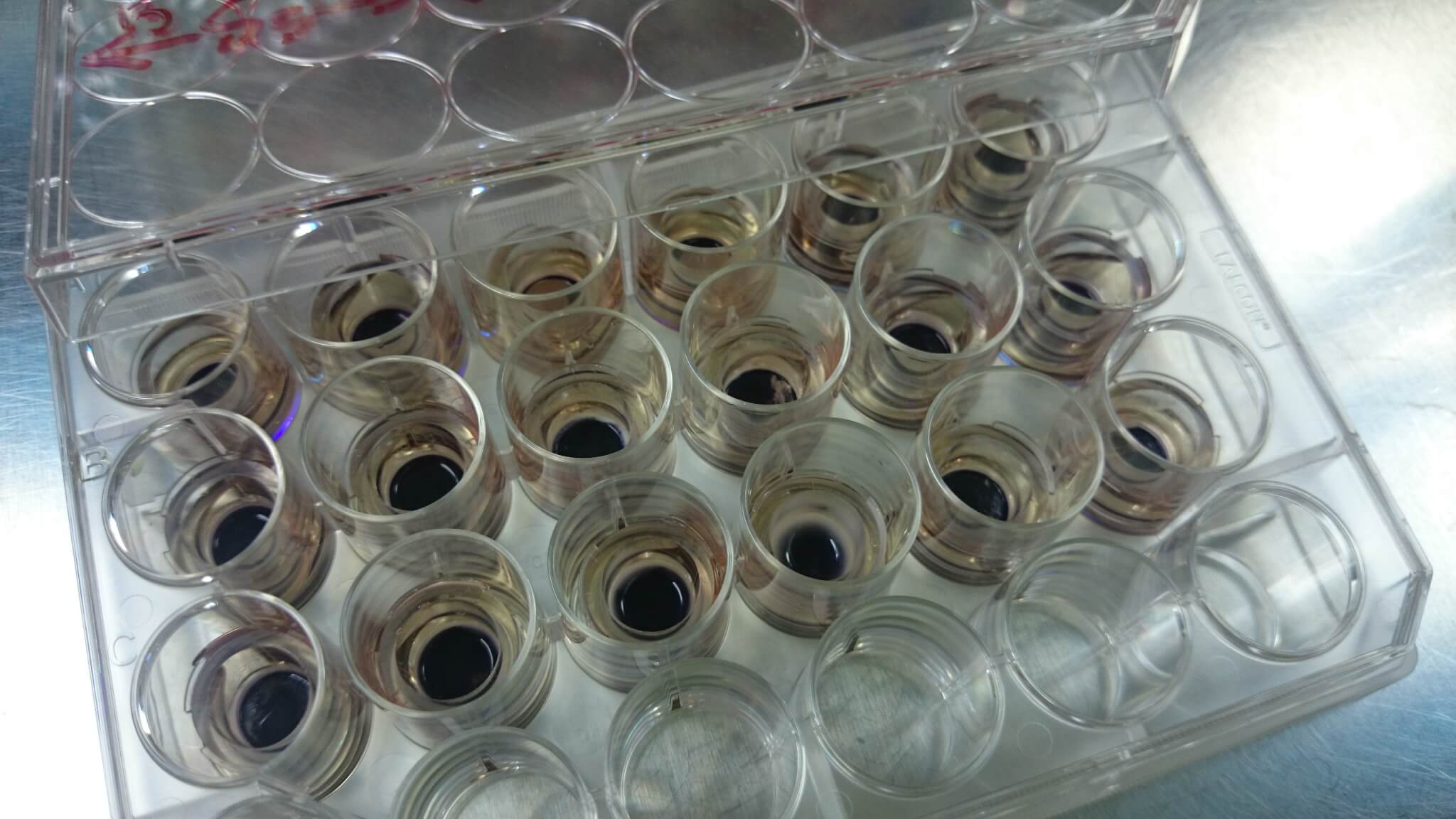
The tissue is exposed to the test substance or finished product under controlled laboratory conditions. Cell viability is quantified using the MTT assay, which measures the conversion of MTT to formazan by metabolically active cells. Formazan absorbance is measured spectrophotometrically and compared with established viability thresholds. High tissue viability indicates that the substance is unlikely to cause eye irritation, while reduced viability suggests irritation potential.
Regulatory Relevance
The method is ECVAM validated and performed according to OECD Test Guideline 492. It supports classification decisions under the UN GHS and Regulation (EC) No. 1272/2008 (CLP).
In vitro Skin Irritation OECD 439
Overview
Skin irritation potential is assessed using the EpiDerm™ model, a reconstructed three‑dimensional human epidermis that replicates the structure and barrier function of human skin.
Τest Protocol
Following exposure of the tissue to the test product, cellular viability is determined using the MTT assay. Metabolically active cells convert MTT into blue formazan salts, allowing the quantification of cellular metabolic activity. Formazan absorbance is measured spectrophotometrically and compared with positive and negative controls according to OECD Test Guideline 439 to determine whether the tested substance should be classified as a skin irritant.
Regulatory Relevance
This method is internationally validated by ECVAM and widely accepted for safety assessment of cosmetics, medical devices, chemicals, and raw materials.
In vitro Skin Corrosion OECD 431
Overview
The ability of a substance or product to cause irreversible skin damage (corrosion) is evaluated using the EpiDerm™ reconstructed human epidermis model.
Τest Protocol
The tissue is exposed to the test sample for defined time periods and cellular viability is determined using the MTT assay. Results are compared with appropriate positive and negative controls and interpreted according to the classification criteria defined by the UN GHS and Regulation (EC) No. 1272/2008 (CLP).
Regulatory Relevance
The test follows OECD Test Guideline 431 and provides reliable toxicological data without the use of experimental animals. It is an ECVAM validated method and regulatory accepted for safety assessment of cosmetics, medical devices, chemicals, and raw materials
In vitro Inhalation Toxicity Testing
Overview
Potential inhalation toxicity can be evaluated using the EpiAirway™ model, a three‑dimensional human airway epithelial tissue that reproduces key structural and functional characteristics of the respiratory epithelium.
Τest Protocol
The surface of the tissue is exposed to the test substance under controlled laboratory conditions. Following exposure, cellular viability is measured to determine potential toxic effects. This model provides relevant data for inhalation risk assessment and supports the broader implementation of the 3Rs principles in toxicology by reducing the need for animal testing.
In vitro 3T3 NRU Phototoxicity Test OECD 432
Overview
Phototoxicity is an adverse reaction that occurs when a substance becomes toxic after exposure to light, particularly ultraviolet radiation.
Τest Protocol
The 3T3 Neutral Red Uptake (NRU) assay measures the viability of mouse fibroblast cells (Balb/c 3T3) based on the uptake of Neutral Red dye. Cell viability is measured both in the presence and absence of UVA irradiation. Differences between light and dark conditions allow identification of phototoxic potential.
Regulatory Relevance
The assay is performed according to OECD Test Guideline 432 and is widely used for the safety assessment of cosmetics, cosmetic ingredients, medical devices and chemicals.
Eye Irritation / Serious Eye Damage Classification – OECD 492 & OECD 437
Overview
Assessment of eye irritation and serious eye damage potential is essential for product classification, labeling, and preparation of Safety Data Sheets (SDS) in accordance with international regulatory frameworks.
Testing Strategy
At QACS Lab, a tiered in vitro testing strategy is applied using internationally recognized OECD methods:
- OECD TG 492 / 492B – Reconstructed Human Corneal Epithelium (RhCE) models for identifying substances not requiring classification for eye irritation.
- OECD TG 437 – Bovine Corneal Opacity and Permeability (BCOP) assay for identifying substances causing serious eye damage (Category 1).
- OECD TG 496 – Ocular Irritection® test method for identifying substances not requiring classification for eye irritation or serious eye damage.
Outcome
Based on the results, products may be classified as:
• Non‑irritant
• Eye Irritant (Category 2)
• Serious Eye Damage / Corrosive (Category 1)
Regulatory Relevance
These methods are performed in accordance with the relevant OECD Test Guidelines and are used within an Integrated Approach to Testing and Assessment (IATA) following either top-down or bottom-up testing strategies. The approach supports safety evaluation and classification of chemicals, cosmetic ingredients, medical devices, and other industrial products.
Ames Test
Overview
The bacterial reverse mutation assay (Ames test) is one of the most widely used in vitro methods for detecting mutagenic or genotoxic effects of chemical substances.
Τest Protocol
According to OECD Test Guideline 471, the assay uses specific strains of Salmonella typhimurium and/or Escherichia coli to detect point mutations in DNA. Experiments are conducted both with and without metabolic activation (S9 mix) to simulate human metabolic processes.
Applications & Regulatory Acceptance
The test is internationally recognized by regulatory authorities such as REACH and CLP and is widely used for safety evaluation of chemicals, cosmetics, pharmaceuticals, and industrial products.
Antioxidant Testing
Overview
Antioxidants protect skin cells from oxidative stress, a major factor contributing to premature skin aging and loss of radiance.
Τest Protocols/Methods
Several internationally recognized assays are used to evaluate antioxidant activity:
• DPPH Radical Scavenging Assay – measures free radical neutralization capacity
• ORAC (Oxygen Radical Absorbance Capacity) – quantifies antioxidant activity against oxygen radicals
• CAA (Cellular Antioxidant Activity) – evaluates antioxidant protection at the cellular level
Applications
These tests support claims related to antioxidant protection, neutralization of free radicals, and reduction of oxidative stress induced by environmental factors such as UV radiation.
The same analytical approaches can also be applied to cosmetics, raw materials, foods and dietary supplements to support antioxidant‑related claims.
Cytotoxicity Assessment – Neutral Red Uptake (NRU)
Overview
Cytotoxicity testing is a fundamental component of the biological evaluation of medical devices and materials, assessing whether a substance or product may cause toxic effects on cultured mammalian cells.
The test is performed in accordance with ISO 10993-5, part of the ISO 10993 series for the biological evaluation of medical devices, and is widely used to determine the biocompatibility of materials intended for contact with the human body.
Test Protocol
In vitro cytotoxicity is typically evaluated using cultured mammalian cells exposed to extracts of the test material or directly to the test substance under controlled laboratory conditions.Cell viability is assessed using the Neutral Red Uptake (NRU) assay, which measures the ability of viable cells to incorporate and bind the Neutral Red dye within lysosomes. The amount of dye retained by the cells is quantified spectrophotometrically and reflects the proportion of metabolically active cells. Cell viability of treated cultures is compared with untreated control cells. A reduction in cell viability indicates potential cytotoxic effects of the tested material or extract.
Results are interpreted according to the acceptance criteria defined in ISO 10993-5, allowing determination of whether the tested material demonstrates cytotoxic potential
Regulatory Relevance
Cytotoxicity testing according to ISO 10993-5 is a key requirement for the biocompatibility assessment of medical devices, as well as for materials used in pharmaceuticals, cosmetics, and consumer products.
The method is widely accepted by regulatory authorities worldwide and supports product safety evaluation, regulatory submissions, and technical documentation for medical devices and related products.
In Vitro Testing Services provided by QACS are categorized according to the objective of the study and the type of product being evaluated.
- In Vitro testing services for claims support are mainly designed for cosmetic products and include assessments of skin and eye compatibility and non-irritancy, as well as studies on antioxidant activity and Sun Protection Factor (SPF), conducted in accordance with internationally recognized protocols and standards.
- In vitro testing services for regulatory compliance primarily support medical devices, providing the scientific data required for the preparation and submission of product dossiers to the relevant regulatory authorities.
- In vitro safety testing (Safety – GLP) is applied to chemicals and professional-use products when documented evidence of safety for users and consumers is required. These studies are performed in accordance with the Principles of Good Laboratory Practice (GLP) to ensure the reliability and regulatory acceptance of the results.
- Finally, in vitro toxicological studies support the preparation of Safety Data Sheets (SDS/MSDS) for chemical substances. When necessary, these studies may be conducted in collaboration with specialized external laboratories to ensure comprehensive toxicological evaluation.
View our Toxicological Testing services brochure here